Assumptions
Portfolio Growth
The portfolio value grows annually based on the net return, which is calculated as Investment Return minus Management Fees. The calculation assumes annual compounding.
Financial Phases
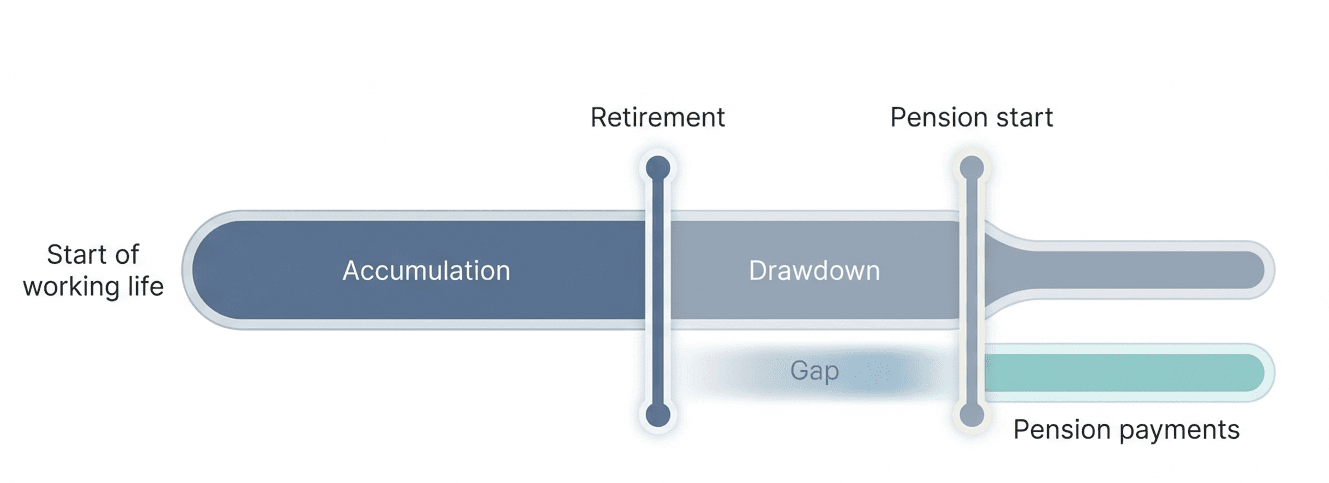
The simulation models three distinct phases: Accumulation (saving phase), Drawdown (pre-pension), and Drawdown (with pension). Retirement age and pension start age are independent, creating a potential gap period that must be funded from savings.
Accumulation Phase
During the accumulation phase (from current age until retirement age), the annual savings amount is added to the portfolio at the end of each year, after applying the growth.
Drawdown Phase (Pre-Pension)
Starting from retirement age until pension start age, the annual spending amount is subtracted from the portfolio at the end of each year, after applying the growth. This period represents the gap between retirement and when pension payments begin.
Drawdown Phase (With Pension)
From pension start age onwards, both spending and pension income are applied. The annual spending amount is subtracted from the portfolio, while pension income is added to the portfolio at the end of each year, after applying the growth.
Depletion Age
The depletion age is calculated when the portfolio value reaches zero. If the portfolio remains positive until age 100, it is considered sufficient for the simulation period.
Real Returns
All returns are expressed in real terms (after inflation). This means the portfolio values shown represent purchasing power, not nominal amounts.
Annual Compounding
Returns are compounded annually. All transactions (savings, spending, pension) occur at the end of each year.
Constant Parameters
All input parameters (returns, fees, savings, spending, pension) remain constant throughout the simulation period. This is a simplification for modeling purposes.
No Taxes
The simulation does not account for taxes on investment returns, spending, or pension income. Actual results may vary based on individual tax situations.
Note: Note: This simulation uses simplified assumptions and should not be considered as financial advice. Real-world scenarios may differ significantly due to market volatility, tax implications, and other factors.